


Poultry farming that
builds local resource circulation
and a shared landscape

 Skip to content
Item added to your cart
Prices shown include tax. Shipping will be calculated at checkout.
View cart点々Original
Subscription | Free-range fertilized eggs raised through resource circulation in Nishiawakura Village, Okayama
Subscription | Free-range fertilized eggs raised through resource circulation in Nishiawakura Village, Okayama
Taxes included.
Regular price
¥2,808
Regular price
Sale price
¥2,808
Unit price
per
Room temperature delivery (refrigerated from July to September) *For subscription customers, room temperature shipping fees will be applied year-round, including during summer refrigerated delivery periods.
Couldn't load pickup availability
Subscription Information
Subscription Information
Please be sure to read the "Subscription Service" section in our Store Guide before placing your order.
Your subscription will be processed automatically according to your selected delivery schedule, saving you the inconvenience of placing an order each time and helping ensure you never run out.
Subscription orders are shipped on Mondays, Tuesdays, Thursdays, and Fridays.
Please refer to the estimated delivery times listed at the top of the Store Guide when selecting your preferred shipping day.
We will notify you of your first shipping date within four days of placing your order. If we are unable to accommodate your requested shipping schedule, we will contact you by email.
Please note: By enrolling in a subscription, you commit to a minimum of three deliveries.
Customers who subscribe to Ten Ten eggs will automatically be enrolled as Ten Ten Membership members.
For more information, please click here.
Shipping Information
Shipping Information
Products are shipped by room-temperature, refrigerated, or frozen delivery, depending on the product. Please check each product page for the applicable shipping method.
If you order both room-temperature and refrigerated products, they will be shipped together via refrigerated delivery whenever possible to reduce shipping costs and packaging.
Frozen products cannot be shipped together with room-temperature or refrigerated products.
We will make every effort to pack your order into a single box. However, if your order exceeds the capacity of our largest box, additional boxes may be required, resulting in extra shipping charges.
If additional shipping charges apply, we will recalculate the shipping fee after your order is placed and send you an email requesting payment for the additional shipping cost.


- Story
- Item Info
Tenten's Eggs are fertile free-range eggs produced in a newly constructed chicken coop on reclaimed farmland in the Chisha village of Nishiawakura, located in the northeastern part of Okayama Prefecture. The chickens are fed a homemade fermented feed made primarily from local unused resources such as rice, barley, and vegetables. They are raised in a free-range environment where they can roam freely within the coop, rather than being confined to cages, and are co-habitated by both male and female chickens. These fertile eggs have a clean taste and are so delicious that you can enjoy them every day without getting tired of them.

[A circular community starting with chicken farming]
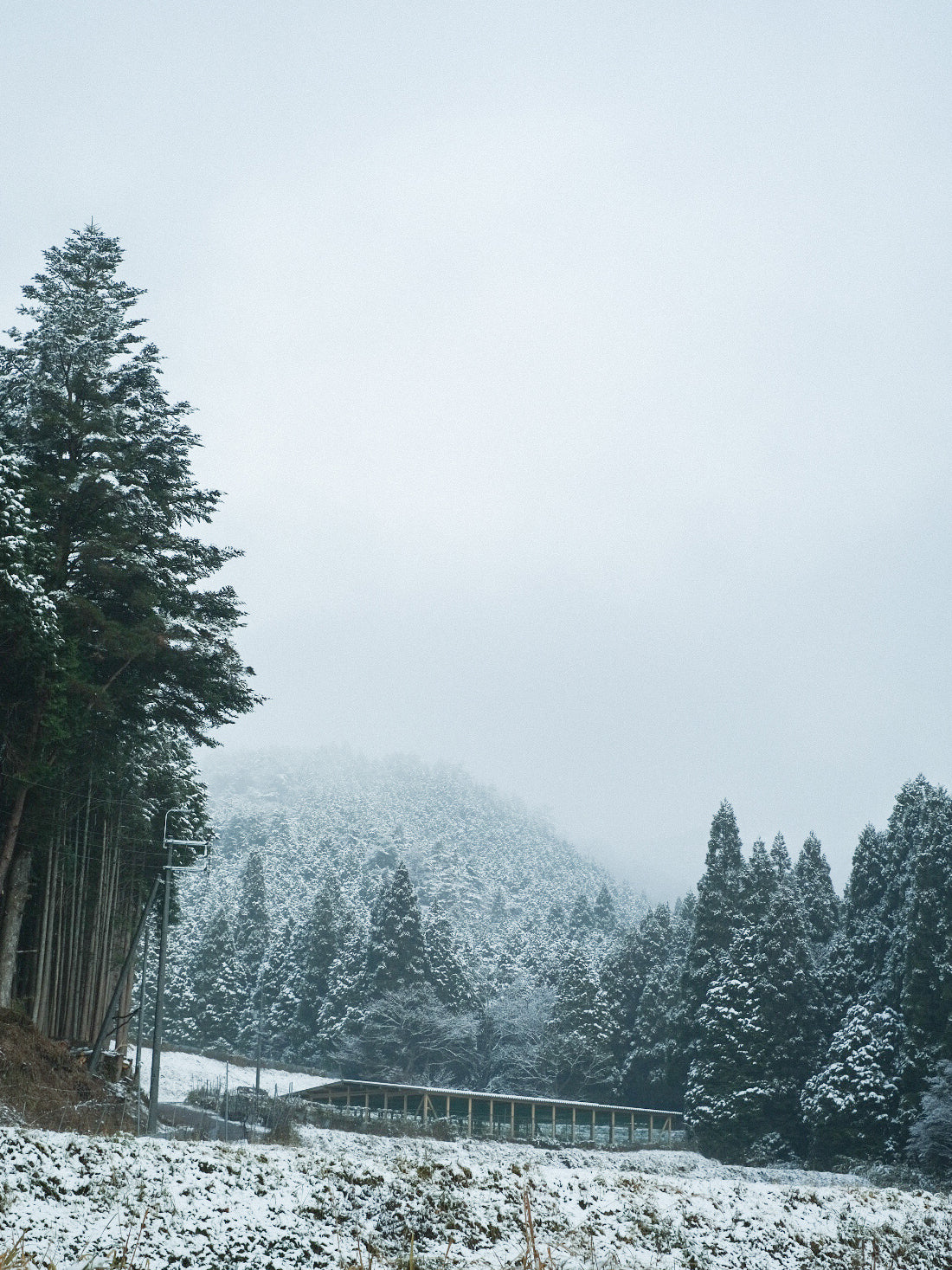
Our base is a small mountain village of about 20 households and 40 people. We raise healthy chickens amidst the changing seasons of the satoyama (traditional rural landscape), with clear air, pure headwaters, and silently falling snow.
Unused resources such as weeds from mowing, off-spec rice, and vegetables become feed for the chickens, and the chicken droppings become fertilizer for field crops. We are practicing a circular community where local unused resources are recycled, starting with free-range chicken farming.

[Low-density free-range chicken farming]
We practice low-density free-range farming that respects the natural ecology of chickens: basking in the sun, running around and dust-bathing, and sleeping on perches at night. By allowing chickens to run freely, they build strength and grow into healthy bodies that are less susceptible to illness.
We keep flocks small, at 200 chickens, and maintain a standard of 2 chickens per square meter, which is about five times the space of typical free-range farming. This allows us to keep a close eye on each chicken and monitor their health.

[Homemade fermented feed of Japanese origin]
We do not feed our chickens commercial compound feed, colorants to intensify yolk color, or additives such as preservatives or flavorings. We use rice and barley produced locally as our main ingredients, along with okara (soy pulp), rice bran, vegetable scraps, and weeds from mowing. We mix and ferment these ingredients ourselves to create our own feed.
We want to be producers who can clearly explain to our customers "what our chickens eat."

[Purebred Japanese chicken "Goto Momiji"]
"Goto Momiji," which we raise, is a breed improved to suit the Japanese climate and is one of the purebred Japanese chicken varieties that accounts for only 4% of the domestic market.
Since we primarily feed them our homemade feed, along with plenty of natural green grass and vegetable scraps, the yolk color is "lemon yellow" rather than "dark orange." The taste is light, but it has a rich aroma and gentle umami, making it delicious enough to eat every day without getting tired of it.
Please enjoy the changing flavor and yolk color of the eggs, which vary depending on the season, feed content, chicken preferences, and health conditions—a result of an environment that closely mimics their natural habitat.
About the eggs
・The yolk color is lemon yellow. The color varies slightly depending on the season as the feed ingredients and proportions are adjusted.
・Although the breeding environment allows for natural mating with a ratio of at least 5 males per 100 females, the fertilization rate is not 100%.
For FAQs about eggs, please refer to the Store Guide.
We introduce recipes using this product. Please see Stories Recipes.
-
Barrel-aged tamari soy sauce with dashi for eggs
Regular price ¥1,296Regular priceUnit price per -
Suji Aonori grown in Kochi's beautiful seawater
Regular price ¥864Regular priceUnit price per -
 Sold out
Venison sausage
Regular price ¥1,080Regular priceUnit price per -
Wild venison hunted in the village | Ground
Regular price ¥2,160Regular priceUnit price per -
Free-range fertilized egg mayonnaise made with upcycled ingredients
Regular price ¥1,512Regular priceUnit price per¥1,512Sale price ¥1,512 -
Polka dot tenugui
Regular price ¥1,760Regular priceUnit price per -
 Sold out
Wild venison caught in the village
Regular price From ¥972Regular priceUnit price per

We raise our chickens on a fermented feed made directly from local rice, vegetables, and other ingredients, then use the chicken manure as fertilizer for new crops, building resource circulation and a shared landscape starting from poultry farming.


- Choosing a selection results in a full page refresh.
- Opens in a new window.